
Welcome to Mindful Monday, where we bridge the gap between Second Language Acquisition research and the practical realities of both your classroom and your business. Each week, Leo and I share research-backed insights to help you sharpen your classroom teaching while building the freedom to work on your own terms.
See our CPD Courses & Materials here.
In partnership with: FLUENTIZE
Want to teach your best lessons – without all the prep?
Fluentize turns real-world videos into interactive ESL lessons for teens and adults. Explore 650+ ready-to-teach lessons designed to engage your students, simplify lesson planning, and save you hours of preparation.
Get 25% off an annual Fluentize subscription with code “TTT25” at checkout.
In partnership with: COMMUNICATING FOR IMPACT
The Creative House for Leading Educators
Stop the technical faff. Start making an impact. Plan your series. Record with ease. Reach your audience. A simple 3-step process to broadcast-grade video and podcasts for educators. Trusted by world-leading experts.
Happy Father’s Day to all who celebrated yesterday and happy summer to those in the northern hemisphere. The days only get shorter from here 😂
In this week’s Mindful Monday, you’ll see:
-
Why AI isn’t coming for teachers [but a version of teaching]
-
Our entrepreneur podcast series is winding down [and what’s next]
-
How do university students use Gen AI?
Hope you enjoy this week’s edition.
🎙️ Is AI coming for teachers?
Researcher Matt Coss says no – but that asking that question worries him.
“ People ask me all the time, are you worried that AI’s gonna take your job? And I tell them, no, but I’m worried that you would ask me that question ’cause it tells me a lot about what you think my job is.”
AI may not be coming for teachers, but perhaps it’s coming for a version of teaching we should have moved beyond years ago.
If all we do is teach vocabulary and grammar, we’re in trouble. And that should make us uncomfortable because a lot of language teaching still revolves around delivering rules, sequencing forms, correcting errors, and treating high accuracy as the proof that learning happened.
Then students enter a task based classroom, use language messily, develop in real time, and still ask.
“When is she going to start teaching us stuff?”
Why?
Because they’ve been conditioned to believe that “teaching” means explicit explanation. And that “learning” means clean performance.
What we liked about it is that Matt pushes us to look at the bigger issue. If messy interlanguage development makes us feel like we’re failing, maybe our benchmark for teaching is the problem.
Watch the full conversation on our Teacher Talking Time Podcast here:
Subscribe to Teacher Talking Time on YouTube.
🎙️ Entrepreneur Series Winding Down
Our teacherpreneur series on the Teacher Talking Time podcast is, sadly, coming to an end.
We are already working on a new project for the podcast, and we’re excited about what comes next, but we have to say, we’re really proud of this series.
It has given us the chance to speak with teachers who have taken their classroom experience and turned it into something bigger: a platform, a business, a community, a resource, or a new way of supporting other teachers.
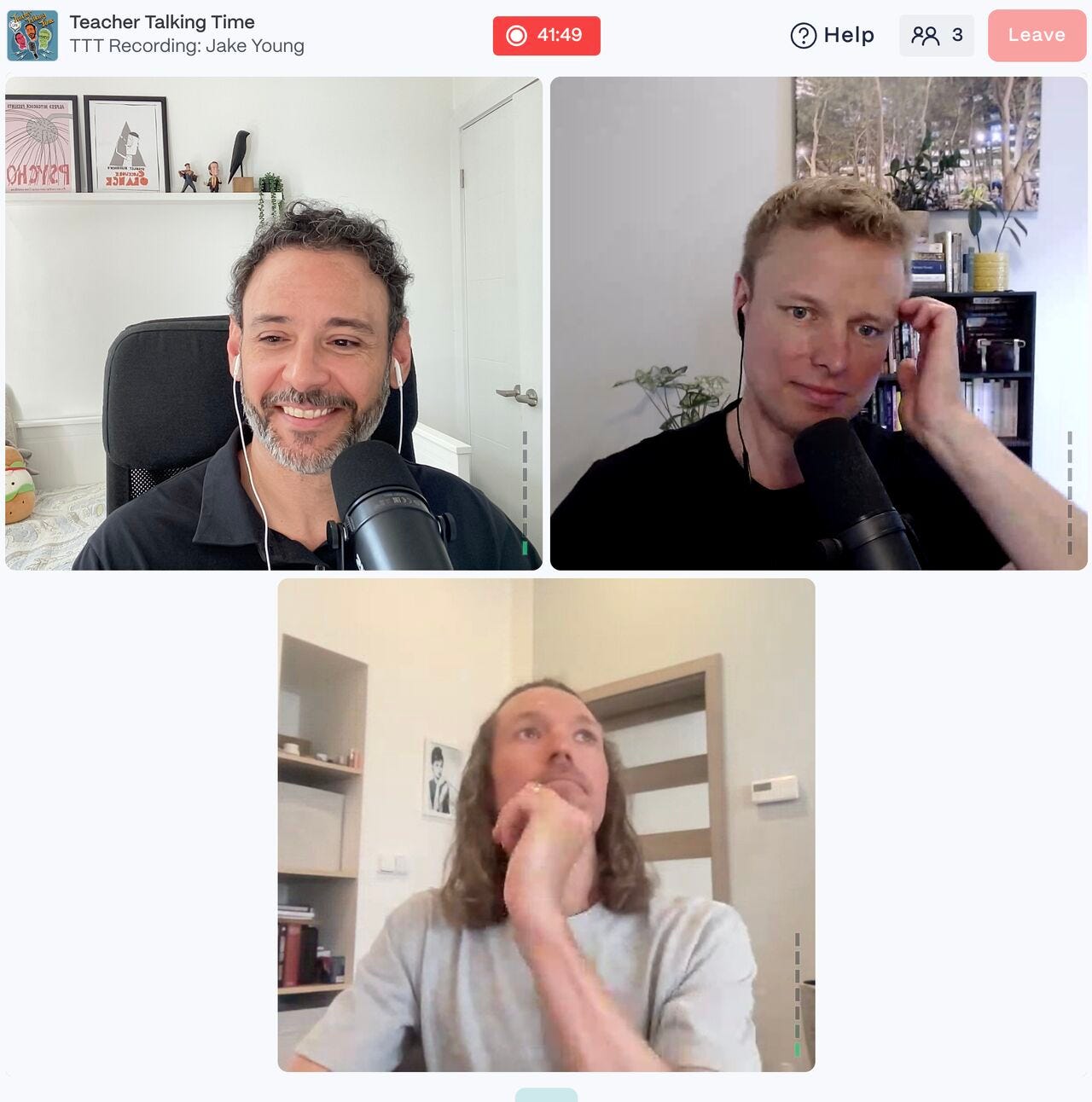
One of our final conversation was with Jake Young from Fluentize.
For those who don’t know Jake, Fluentize is a platform built around video-based ESL lessons. But what I found most interesting about our conversation was that we didn’t talk only about his video platform.
It was about teacher workload.
It was about the difference between teaching and lesson design.
It was about how one teacher’s classroom problem can slowly become a business that helps thousands of other teachers.
And it was about the question so many teacher entrepreneurs face:
How do you build something useful without losing touch with the classroom reality that inspired it in the first place?
Jake shared the story of how Fluentize began with his own private students in Prague, why authentic video became such a powerful teaching tool, and what he has learned from building a resource that teachers around the world now use.
The episode will be coming out in the fall, and I think it will be a great one for anyone interested in materials design, teacher entrepreneurship, authentic content, or simply finding more sustainable ways to teach well.
More to come soon.
🎙️ How do university students ask GenAI to revise or proofread a text?
A framework for analysing prompting strategies
How do university students use generative AI with their work?
What prompts do they use?
Is that teacher supported?
These are questions lots of teachers ask – we know we do at LYE – and it was great to see our friend Graham Burton co-author a new paper about it.
Using AI in academic work is still fairly “open game” so to speak, but how it’s used and what prompts are used is an area of great interest. I know many teachers ask their students to submit their prompts with assignments, but it’s great to have this done empirically.
Here are some highlights of the article the authors point out:
-
An empirical framework to analyse the content and structure of prompts requesting GenAI text revision is proposed.
-
The framework is applied to a dataset of prompts provided by 70 university students.
-
The prompting behaviour of the sample group is inconsistent from a quantitative point of view.
-
On average, students used relatively few pragmatic elements in each prompt, and an even smaller number of unique pragmatic elements.
-
The framework can be used to raise awareness of differing prompting strategies and explore their effects on GenAI output.
This is a topic that needs exploring and this study is a great start.
Missed our podcast with Graham Burton? Catch it here:
We may need to have Graham back on the show to talk about this new study.
That’s all for this edition. Talk next Monday,
Leo and Andrew
Want to grab a coffee and strategize the next step of your business?
If you enjoyed this, the best compliment we could receive would be if you shared it with one person or restacked it on Substack.