
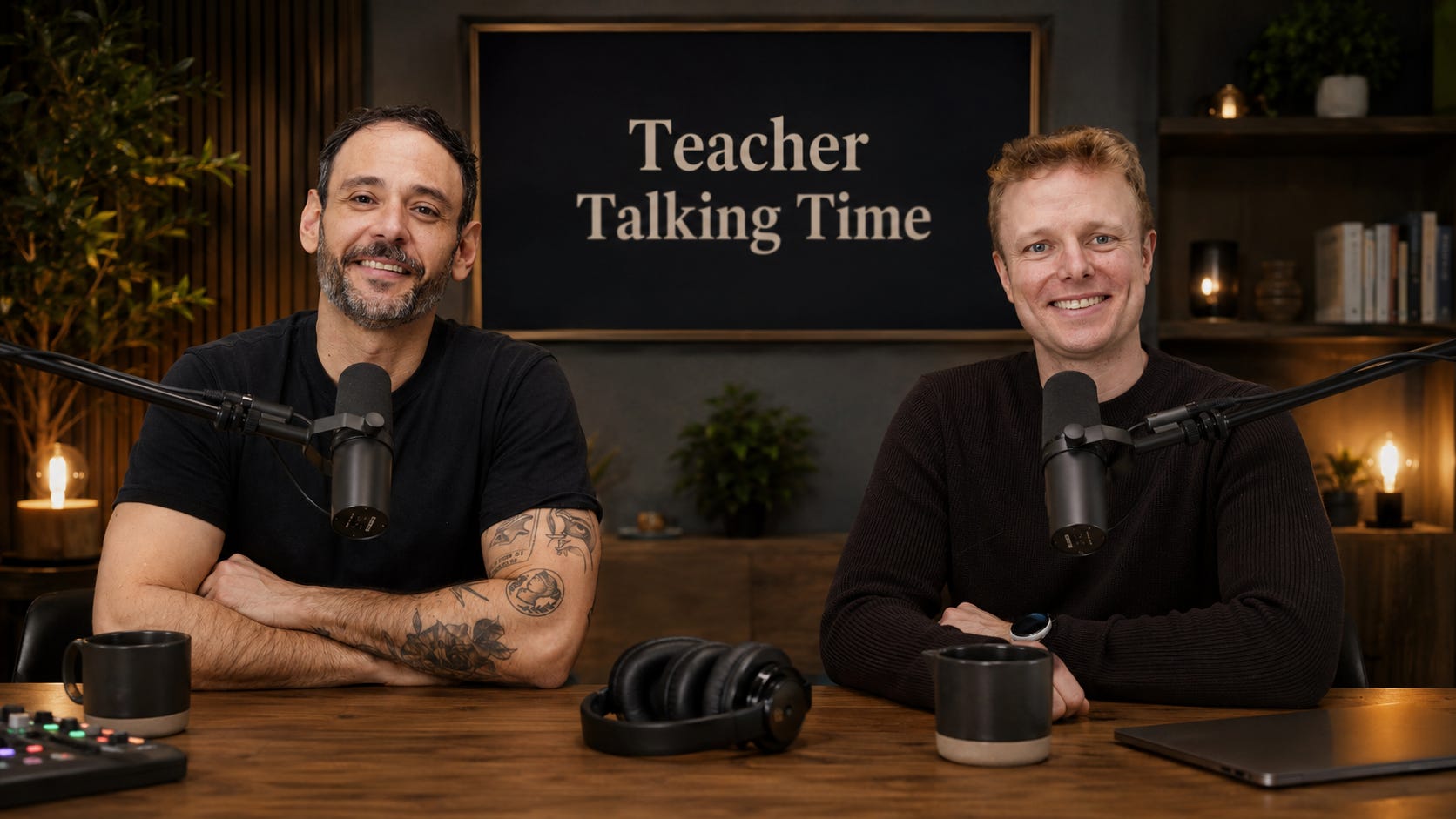
Welcome to Mindful Monday (going out a Tuesday), where we bridge the gap between Second Language Acquisition research and the practical realities of both your classroom and your business. Each week, Leo and I share research-backed insights to help you sharpen your classroom teaching while building the freedom to work on your own terms.
See our CPD Courses & Materials here.
In partnership with: Pensight
Going independent was supposed to mean keeping more of what you earn — and more of your week. Then came the calendar, the video plan, the payment app, the site builder — and all the admin.
Pensight is all of it, one login, a flat $29 a month.

Happy Thanksgiving 🍁 🦃 to our readers in Canada! The fall colours are putting on a show here in Toronto, and we’ve got plenty to look forward to on Teacher Talking Time. We’re grateful to the guests who share their work with us and to all of you who keep listening, reading, and joining the conversation.
In this week’s Mindful Monday, you’ll see:
-
We sat down with Robert DeKeyser!
-
Our fall podcast lineup and a look at who we’re interviewing next
-
What could your own teaching business look like in six months?
Hope you enjoy this week’s edition.
💬 Our conversation with Robert DeKeyser – They know the rule. So why can’t they use it?
Imagine a learner who gets full marks on a grammar test. The next day, in conversation, that same language seems completely out of reach.
That’s one reason we wanted to sit down with Robert DeKeyser. His work on practice, automaticity, and language learning tackles a question teachers recognise immediately:
what happens between understanding something about a language and being able to use it?
Here are three moments from our conversation that stayed with us.
1. Practice needs a message.
Robert stressed that practice should involve communicating ideas and exchanging information. Repeating a pattern without understanding its message misses something essential.
Are learners getting better at the exercise, or at communicating?
2. Repetition doesn’t have to mean boredom.
While teaching English to birdwatching guides in Colombia, Robert repeatedly had them help a visitor locate a bird. Different birds, different locations, same practical purpose. In their final class, they asked to do it again!
What task would your learners want another chance to get better at?
3. Faster isn’t the whole goal.
For Robert, automaticity involves speed, accuracy, and reduced effort. He also cautioned against adding time pressure too early. Sometimes learners need to slow down before they can speed up.
When speech gets smoother, is it also becoming more accurate and less effortful?
Plenty to think about, and plenty more in the conversation.
Which of these questions comes up most often in your teaching? Reply and let us know.
🎙️ Coming up on Teacher Talking Time
We’ve got some exciting conversations lined up!
Here’s a quick look at who we’ll be sitting down with:
Neil Mercer: Oracy and thinking together
Neil is Emeritus Professor of Education at the University of Cambridge, whose work explores how classroom talk helps learners reason, collaborate, and build understanding. We’ll be talking about oracy, developing speaking and listening skills, and how teachers can help learners think together through dialogue.
Jeremy Harmer: English language teaching
If you’ve spent time in teacher education, you may recognise Jeremy’s name from The Practice of English Language Teaching, his guide connecting teaching principles with classroom practice. We’re delighted to have him joining us for a conversation about our profession.
Liam Printer: Comprehensible input and motivation
Liam is a language teacher, researcher, and host of The Motivated Classroom podcast, whose work connects storytelling, language learning, and motivation. He’ll join us to explore comprehensible input and what it can look like in the classroom.

What would you like us to ask them? Reply to this email with your questions. We’d love to bring a few into the conversations.
☕ What could you build in six months?
You know how to teach. You’ve developed materials, helped learners make progress, and probably had a few ideas for something of your own.
But choosing an idea, finding the right learners, and putting a price on it? That can feel like a different job altogether.
Andrew and I have been working on helping teachers take those next steps with a practical six-month plan.
In one recent conversation with a client, we explored how a her teaching interest in reading could become a focused programme for adults who struggle to understand the texts they encounter at work or university.
The starting point was simple:
find out more about those learners’ needs, shape one clear offer, and test it with a small paid group. Then use what you learn to improve the programme and prepare the next launch.
Here’s what that could look like:
-
Months 1–2: Shape your offer. Identify who you want to help, understand their needs, and develop a programme with a clear outcome. Start conversations with potential clients and recruit a small paid pilot.
-
Months 3–4: Teach, learn, and refine. Deliver your first version, gather feedback, and review the price, preparation time, and learner experience.
-
Months 5–6: Prepare your next launch. Improve your programme, create a simple way for people to find and book it, and build a recruitment routine that fits your life.
That’s the kind of work we help with: choosing your audience, developing your offer, finding your first participants, and making decisions as you go.
Throughout, you’ll have monthly planning meetings, feedback on your work, access to our training, and support between meetings.
The aim is to help you build an offer you can explain, sell, deliver, and improve, with clear steps and someone to work through them with.
Have an idea you’d like to explore?
Book a chat with us. Let’s explore what your next six months could look like
That’s all for this edition. Talk next week,
Leo and Andrew
Want to grab a coffee and strategize the next step of your business?
Thanks for reading! This post is public so feel free to share it.
Wanna learn more about what we do at Learn YOUR English?
1. Subscribe to our Teacher Talking Time podcast here