
“My students aren’t ready for tasks.”
I hear this a lot. And sometimes it’s true; the activity really is too demanding. Too much to read, too much to hold in working memory, too little scaffolding for learners to understand what they’re actually supposed to do.
But I’ve started asking a different question when I hear it.
What could these learners manage, with what input and support?
That little shift changes things. It moves the problem from the learner to the design.
In Part 1, we looked at 3 reasons to consider TBLT: giving language a purpose, creating a reason to listen, and providing a context for working on grammar and vocabulary. Here are the final 2.
In partnership with: MAURIL
Authentic Canadian content for your English and French students—100% free!
Help your students improve their language skills with Mauril, a free, ad-free app developed by CBC and Radio-Canada.
Mauril uses real-world documentaries, news segments, podcasts, and shows to make language learning engaging and culturally immersive. No subscriptions, no ads, just great Canadian media.
iOS | Android | Mauril website (available in Canada only).
4. It gives beginners ways to participate
When people picture a task-based lesson, they usually imagine learners talking. Pairs, groups, extended discussion.
But tasks don’t have to start there.
A beginner might listen to a description and select the correct picture.
Follow simple directions and mark a route on a map.
Read short messages and choose an appropriate appointment time.
They have something to accomplish, even if their spoken language is limited.
Take a picture-selection task. The teacher describes someone’s bag. Learners look at several options and choose the one that matches. They show their understanding by pointing or selecting; no extended production required.
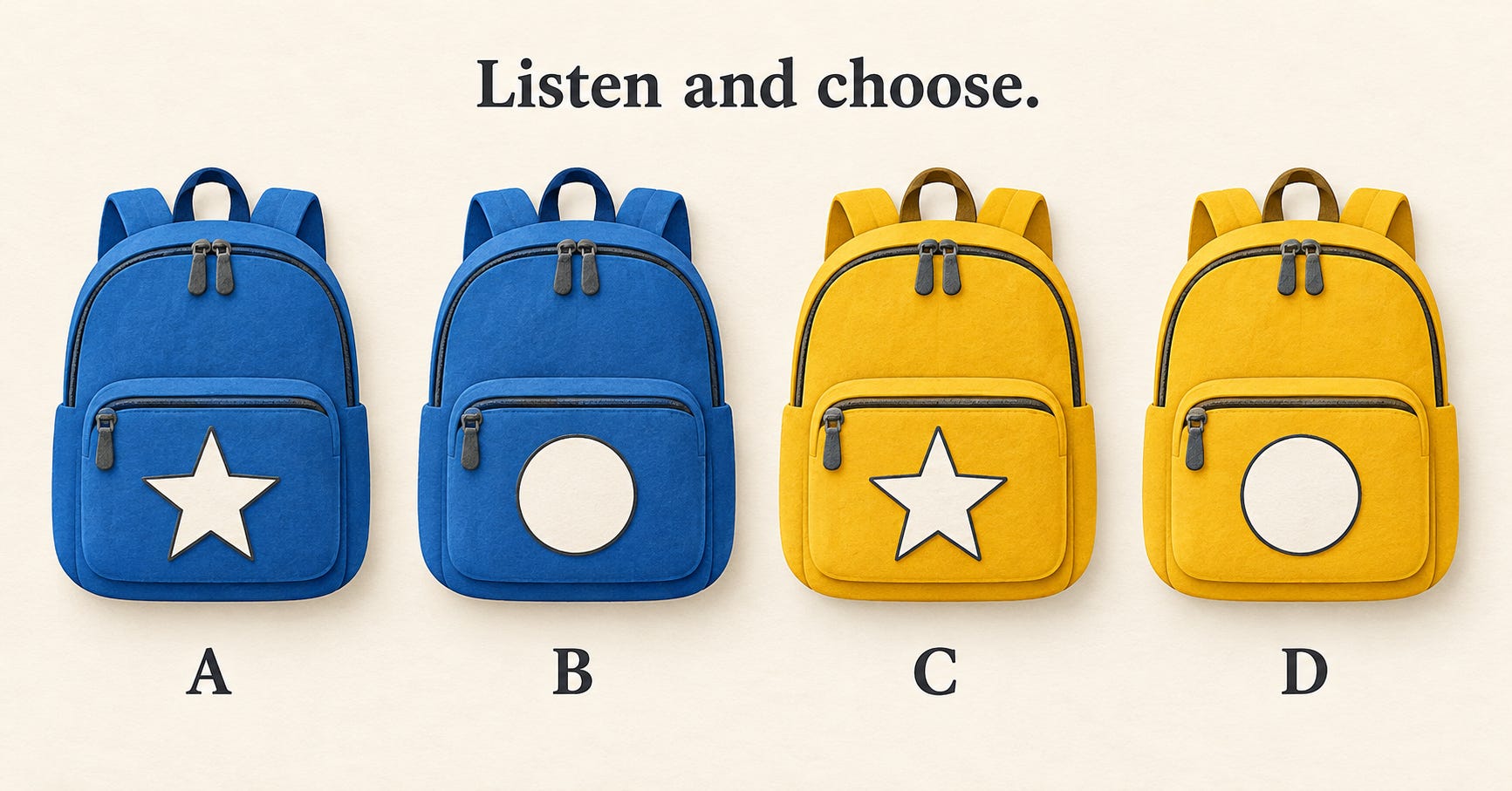
The task can be made accessible through pictures, gestures, repetition, and space to ask for clarification. Participation doesn’t depend on learners producing a complete description themselves.
Shintani (2012) studied repeated listen-and-do tasks with 15 six-year-old beginners of English. Compared with a control group, the task group made gains in understanding and producing the target vocabulary, and in understanding the plural -s.
I know it’s one small study. But it shows something worth reflecting, especially if you’re skeptical about tasks:
beginners can learn through carefully supported tasks without being required to produce language from the outset.
So I’d replace “Are they ready?” with:
what task could they manage, with what input and support?
5. It gives you something concrete to observe and revisit
A clear outcome helps you see what learners can actually do.
-
Did they agree on a meeting time that works for everyone?
-
Did they follow the directions accurately?
-
Did they retell the important parts of the story?
And then you can look at the language involved.
-
Where were learners clear?
-
Where did communication break down?
-
What could they manage on their own, and what needed your help?
Then give them another opportunity.
In the Nostalgia task cycle we use in TBL4T, participants return to their stories after a language focus stage and tell them again to a new partner. They have another chance to express something they’ve already thought about, with a listener who has a genuine reason to understand them.
Lambert, Kormos and Minn (2017) studied 32 Japanese learners of English and found immediate fluency gains across repeated performances of the same oral task.
One improved performance isn’t proof of lasting learning or transfer. But repetition gives learners another attempt and teachers something specific to compare. Fewer pauses. A clearer explanation. Less need for support. Those observations tell you something about what to do next.
This is the spirit of the Lesson Study work in TBL4T:
plan, observe what learners actually do, and revise. What happened in the room matters more than whether the lesson followed the plan exactly.
Where could you begin?
You don’t need to redesign your entire course this week.
Pick one familiar activity and run it through Ellis’s (2009) task criteria:
-
Meaning: are learners mainly trying to understand or communicate a message?
-
Gap: is there something to find out, work out, or express a view about?
-
Own resources: can learners draw on their own language and strategies?
-
Outcome: is there something to achieve beyond displaying correct language?
Then choose one change.
Maybe learners currently describe their own schedules without needing to listen to anyone else. Could you ask them to agree on a time when everyone is free? Give them the input and preparation they need. Observe what happens. Work on useful language. Give them another opportunity.
A few notes afterwards go a long way:
what could they do, where did they need help, what would I change?
Trying one task is a starting point. Organizing a whole course around tasks involves further decisions. Decisions about learner needs, sequencing, support, and assessment. Different versions of TBLT make different choices, and those differences are worth examining rather than treating every model as interchangeable.
For me, the appeal has always been practical.
Tasks give you a way to connect what learners need to do, the language they encounter, the support you provide, and the evidence you collect … all in the same lesson.
Which activity in your next lesson could you redesign around something learners need to understand, decide, or accomplish?
Two conversations to explore next
If you’d like to keep thinking about the practical side, these Teacher Talking Time episodes are useful companions:
-
Jane Willis: her discussion of tasks with beginners starts at 56:30. Listen to Episode 25.
-
Claudia Fernández: we discuss implementing a task-based Spanish programme, including needs analysis, task design and assessment. Listen to Is a TRULY task-based curriculum possible
Choose the conversation closest to a question you’re working on, and bring one idea back to your own teaching.
Want to experience TBLT in action?
If you’d like to experience task-based teaching for yourself, I’d love you to join us in TBL4T.
You’ll take part in tasks as a learner, then step back with other teachers to examine what happened: what helped, what language emerged, and what you might change for your own classroom.
Across 10 live sessions, we connect those experiences to research, task design, feedback and assessment, with opportunities to develop and revise your own materials.
Bring your teaching context, your questions and one activity you’d like to rethink.
👉 Join us in Task-Based Learning for Teachers (TBL4T).
References and further reading
Ellis, R. (2009). Task-based language teaching: Sorting out the misunderstandings. International Journal of Applied Linguistics, 19(3), 221–246. Read it here
Shintani, N. (2012). Input-based tasks and the acquisition of vocabulary and grammar: A process-product study. Language Teaching Research, 16(2), 253–279. Read it here.
Lambert, C., Kormos, J., & Minn, D. (2017). Task repetition and second language speech processing. Studies in Second Language Acquisition, 39(1), 167–196. Read it here.
Bygate, M. (Ed.). (2018). Learning language through task repetition. John Benjamins. Book.
If you enjoyed this, the best compliment we could receive would be if you shared it with one person or restacked it on Substack.
Thanks for reading! This post is public so feel free to share it.